Best Time to Visit Greece: April, May or June?
May gives the most reliable Greek sunshine and June the warmest evenings, while April suits sightseeing. Compare typical temperatures, rain and crowds.
On this page
May is the best all-round month for most trips to Greece: warm days, long evenings and an island network running at close to full summer rhythm. April suits anyone who wants to walk ruins and hills without heat, and June is the right choice if you want evenings that stay warm and a dependable chance of lying by the water.
The catch with treating Greece as one climate is that the same week behaves very differently on the mainland north, the Ionian coast and the southern Aegean. May is a strong middle for the country as a whole, but the further south and east you go, the earlier the season arrives.
Which month suits which kind of trip
Pick April if the trip is about archaeology, village walking and long days outdoors, and you accept that evenings need a jacket and the sea is not the point. Pick May if you want a bit of everything: ruins before the heat, taverna lunches outside and island ferries running a fuller network, with bank holidays and half term the main pressure points. Pick June if sitting out late matters more than sightseeing stamina.
A practical rule is to match the month to your heat tolerance rather than a photograph. Anyone who wilts above the mid-20s Celsius should treat June in Athens as a short-break month rather than a touring month, while anyone who finds 19 °C afternoons chilly will be happier from mid-May onwards.
How Greek weather varies from north to south
Greece is several climates wearing one flag, and the national normals show it. Thessaloniki airport averages 19.3 °C (66.7 °F) by day in April, while Rhodes reaches 20 °C (68 °F) and Crete's Heraklion 20.3 °C (68.5 °F), so the north starts the season cooler. For more detail, see Greece in april.
Wetness divides the country even more sharply than temperature. Thessaloniki records 11.2 rain days and 37.5 mm in April and 10.7 rain days in May, while Kefalonia drops from 9.5 rain days in April to 4.6 in May and Rhodes holds 4.6 in May; build a wet-weather day into any northern or western plan.
The Ionian side is the damp end of the country. Corfu averages 19.0 °C (66.2 °F) by day and 12.9 rain days in April, easing to 8.0 rain days in May, which is worth knowing before you commit a week to the west coast in early spring.
Weather in April: typical highs, nights and rain
Athens averages a 20.2 °C (68.4 °F) daytime high and an 11.8 °C (53.2 °F) night in April, with 9.7 rain days and 26.0 mm of rain across the month. Heraklion runs 20.3 °C (68.5 °F) and 12.3 °C (54.1 °F), Rhodes 20 °C (68 °F) and 14.2 °C (57.6 °F) and Santorini 18.9 °C (66.0 °F) and 13.3 °C (55.9 °F), so afternoons are pleasant while nights still feel like early spring.
Rain is a real feature rather than a rounding error. Rhodes sees 7.6 rain days in April, Heraklion 7.7 and Kefalonia 9.5, and Kefalonia's 60.4 mm makes it the wettest of the stations here. Expect one or two washed-out half-days in a week and plan a museum or a long lunch for them.
Showers aside, this is the most comfortable sightseeing month of the year. Climbing to the Acropolis or walking a Cretan gorge at 20 °C is a different experience from doing it at 30 °C, which is why walkers and ruin-hoppers tend to rate April so highly.
Is April warm enough for sightseeing and walking?
Yes, comfortably, provided you plan around the mornings and accept a cool evening. Days in the low 20s Celsius are ideal for archaeological sites, hill villages and coastal paths, and you will want a layer for the hours after sunset and for tavernas that put tables outside in the evening.
Santorini and Kos show why the southern Aegean is the safer bet for warmth: Santorini averages 18.9 °C by day and 13.3 °C at night, Kos 19.2 °C and 12.9 °C, so nights are the gentlest of the islands covered here. The trade-off is that the sea lags well behind the air well into June.
If you want more heat without going far, look south and east. Crete and Rhodes are the warmest of the mainstream islands this month, and our guide to warm places in Europe in April sets them against Sicily, Andalusia and the Canaries if you are still choosing a country.
Early vs late April and the Easter effect
Late April is usually warmer and drier than the first week, and the difference matters most in the north. Thessaloniki averages 19.3 °C, but its 11.2 rain days are not spread evenly, so a late-month booking stacks the odds in your favour; the same logic applies on Corfu, at 12.9 rain days for the month.
The bigger variable is Orthodox Easter, which moves with the church calendar and can fall in April or early May, pulling Greek families onto ferries and into village houses at the same time as you. Domestic demand concentrates in the days either side of the holiday, accommodation in popular spots tightens and inter-island seats go first, so if your dates are fixed and tight, hold ferry bookings as soon as they open rather than leaving them to the week before.
Easter week itself brings closures and altered hours at some sites and a heavy domestic travel peak, which is worth routing around if you want a quiet trip rather than a cultural one. Use it as a reason to pick either early April or the second half of May for an island-hopping itinerary.
Things to do in April
Athens works best early in the season: the Acropolis and the city's archaeological sites are manageable at 20 °C, and the Plaka and Monastiraki backstreets are pleasant for wandering without the summer crush. Give the city two or three days and take a day trip to Delphi or Sounion rather than stacking every ruin into one march.
On Crete, April is walking weather for the lower gorges and coastal paths before the real heat, and it is a good month for the archaeological sites around Heraklion and Chania while the hills are still green. In Rhodes, the old town and Lindos reward a slow day, with 14.2 °C nights and 7.6 rain days setting the pace.
Corfu suits village wandering and inland drives in April, with its 19.0 °C days and 12.9 rain days meaning you should keep plans flexible rather than booking a rigid day-by-day schedule. The island's spring greenery and quieter lanes are the reward for tolerating the showers.
Weather in May: the month the islands open properly
May lifts the whole country: Athens averages 25.2 °C (77.4 °F) by day and 16.1 °C (61.0 °F) at night, Heraklion 23.9 °C (75.0 °F) and 15.6 °C (60.1 °F), Rhodes 23.8 °C (74.8 °F) and 17.8 °C (64.0 °F), and Kefalonia 23.4 °C (74.1 °F) and 14.6 °C (58.3 °F). Rain drops away too, to 6.8 rain days in Athens, 4.4 in Heraklion and 4.6 in Rhodes.
The gap between May and June is smaller than the gap between April and May, which is the single best argument for choosing May if you are flexible. You get three-quarters of the summer experience with less heat, fewer people and softer prices.
Northern and western Greece behave differently. Thessaloniki records 10.7 rain days and 44.4 mm in May, so a Macedonia or Halkidiki trip in May still needs a wet-day plan, while the southern Aegean and Crete are running down towards summer dryness.
Is May warm enough for swimming and lazing outdoors?
Lazing outdoors, yes; swimming, only for the hardy. Air temperatures in the mid-20s Celsius make terraces, boats and coastal lunches genuinely pleasurable, and evenings at 15–17 °C are mild enough to sit out. The water is another matter and lags the air by weeks, so treat a May dip as a bonus rather than the plan; anyone who wants warm sea should look at June.
If reliable swimming is the deciding factor, our month-by-month look at the Best Time to Visit the Greek Islands, Month by Month will help you weigh May against June and September on water warmth as well as crowds.
Things to do in May: mainland sites, Kefalonia and the Cyclades
May is the month for mainland archaeology done properly: Mycenae, Epidauros, Olympia and Delphi are all comfortable at 24–25 °C in the middle of the day, and you can take a midday site visit without the endurance test June brings. Pair a Peloponnese loop with a few days in Athens and you have a well-balanced two-week trip.
Kefalonia is at its best now, with rain days down to 4.6 from April's 9.5 and days around 23.4 °C, which makes coastal walking and boat trips along the west coast realistic rather than a gamble. In the Cyclades, island-hopping becomes practical as the ferry network expands, and walking the older paths on Naxos or Sifnos is still comfortable.
For a dedicated island fortnight, start with our guide to the Greek Islands in May, which sorts the quieter islands from the ones that fill early, and then check specific island plans against the best time to visit Crete if the south is on your list.
Crowds and prices in May
Early May is the sweet spot, with uncrowded sites, easy tables and lower rates than summer. From the two UK bank holiday weekends and the school half term onwards, domestic and British demand rises sharply, and late May feels noticeably busier than the first week, particularly on the islands closest to Athens and on Santorini.
Treat May as value rather than bargain. Rates are below July and August but no longer at April levels, so the saving comes from early-month timing and quieter sites rather than deep discounts; check current fares and accommodation directly, since anything quoted here would be out of date.
Weather in June: heat building, especially in Athens
June is where the country splits in two. Athens averages 30.3 °C (86.5 °F) by day and 20.7 °C (69.3 °F) at night, Heraklion 27.5 °C (81.5 °F) and 19.7 °C (67.5 °F), Rhodes 27.8 °C (82.0 °F) and 21.8 °C (71.2 °F), and Santorini 27.7 °C (81.9 °F) and 20.9 °C (69.6 °F), so the capital is a good three degrees hotter than the islands by day.
Rain effectively stops on the islands: Rhodes records 1.2 rain days in June, Heraklion 1.3 and Kefalonia 1.5, against Athens' 3.7. Kefalonia averages 27.8 °C by day and 18.4 °C at night, which makes the Ionian a gentler June choice than the capital.
Nights are the quiet luxury of June. At 20.7 °C in Athens and 21.8 °C on Rhodes, you can eat outdoors late without a jacket, which is precisely what April and most of May cannot offer.
Is June too hot, and who should pick May instead?
For island time it is rarely too hot; for city sightseeing it often is. Athens at 30.3 °C turns the Acropolis and the Agora into early-morning or late-afternoon visits, and the midday hours are better spent in the Acropolis Museum or under a plane tree with a coffee.
Choose May instead if you are travelling with young children, plan long walking days or want to keep costs down. Choose June if warm evenings, dependable sun and a fuller events calendar matter more than comfortable midday temperatures, and go north if you want heat without the capital's intensity: Thessaloniki averages 29.9 °C by day with 7.5 rain days in June, still wetter than the Aegean.
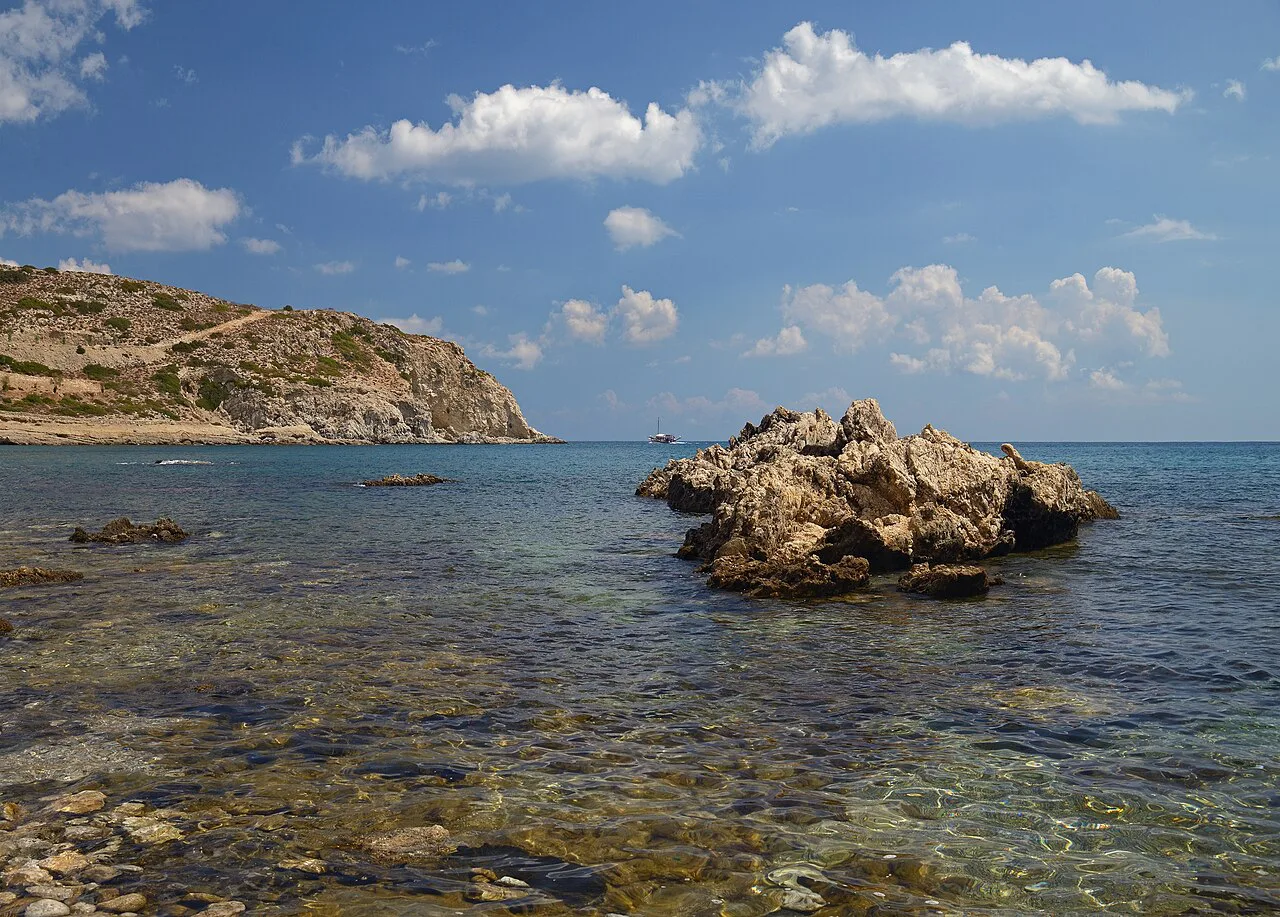
Things to do in June
Rhodes and Crete come into their own in June, with beach time now realistic and 1.2 to 1.3 rain days meaning plans rarely collapse. Boat trips, coastal walks and long taverna lunches all work, and the sea finally matches the season.
The northern mainland is underrated in early summer: Halkidiki and the Peloponnese coast are warm but not yet punishing, and Thessaloniki makes a good city base with 29.9 °C days and 7.5 rain days in June. Just keep a wet-weather day spare.
Culture shifts outdoors too. The Athens Epidaurus Festival opens in June with theatre and music in ancient venues, and a June trip can be built around a performance at Epidauros or the Odeon of Herodes Atticus rather than treated as a beach-only holiday.
Crowds and prices in June
June is busier and dearer than May, and the rise is steepest in the second half of the month as school holidays begin in parts of Europe. Santorini and Mykonos fill up first; Crete, the Peloponnese and the northern mainland absorb the numbers better. Accommodation and ferry fares move into summer pricing, so book the fixed parts of the trip early.
For a like-for-like comparison of where the crowds concentrate, use the island-by-island breakdown before you settle on a route rather than relying on the national picture.
April, May or June: the verdict by traveller type
Sightseers and walkers: late April or early May, when the ruins are comfortable and the paths are quiet. Families with younger children: late May or early June, once the evenings are mild and the ferry network is running fully. Couples and anyone prioritising long outdoor dinners and warm nights: June, on an island rather than in Athens.
Budget-led travellers should favour the first half of May or early April, when demand is lowest outside Easter and bank holidays. Heat-seekers should go in June, and accept Athens as a brief stop rather than a base; those wanting guaranteed swimming should compare May with June and watch the water rather than the air.
If you want the full seasonal picture for the islands before booking, our Greece in June guide covers how the early-summer pattern settles, while Greece in May and our Ionian Islands material help you choose between east and west.
Where to go in Greece in April, May and June
April rewards the south and east: Crete, Rhodes, Karpathos and the Dodecanese give the best chance of dry, bright days, with the mainland north and the Ionian wetter and cooler. Keep Athens for two or three days and use it as a springboard rather than a destination in its own right.
May opens up the Cyclades, the Ionian and the Sporades, with the mainland and the Peloponnese at their most comfortable. If you want a fuller account of the season and its wildflowers, our Greece in spring material covers the mainland shoulder months alongside the islands.
June favours islands over cities. Rhodes, Crete, Kefalonia and the smaller Dodecanese handle 28 °C days better than Athens does, and northern mainland coasts work for anyone who wants heat with a greener landscape and a wet-day margin.
The Verdict
May is the best single answer for a first Greek trip in spring: warm days, mild evenings, ruins that do not exhaust you and islands that are properly open without the summer crush. April is the connoisseur's month for walking and archaeology, and June is the right call when warm nights and reliable sun matter more than comfortable midday touring.
Whichever you choose, check the UK government's Greece travel advice once for entry and local rules, then book ferries and the fixed parts of the trip early if your dates fall near Orthodox Easter, a bank holiday or the school half term.
More Greece spring guides
Frequently Asked Questions
Is April warm enough for sightseeing in Greece?
Yes. Athens averages a daytime high of about 20 °C in April, with Crete and Rhodes similar and Santorini slightly cooler, which is comfortable for walking archaeological sites and hill villages. Evenings drop to around 12 to 14 °C, so plan outdoor dinners with a layer at hand, and expect roughly seven to ten rain days across the month depending on the region. If you want warm sea and mild nights, aim for June on an island instead.
Is May a better month to visit Greece than June?
It depends on what you want from the trip. May brings days in the mid-20s Celsius, quieter sites and lower rates than June, and it is the better month for long walking days and touring cities. June brings nights around 20 °C, far less rain on the islands and a warmer sea, but Athens reaches about 30 °C by day and prices and ferry demand climb, especially in the second half of the month. Choose May for sightseeing value, June for warm evenings and reliable sun.
Which Greek island is warmest in April?
Among the islands covered by the national normals, Crete's Heraklion and Rhodes lead on daytime warmth at around 20 °C, with Kos and Santorini just behind at about 19 °C. Rhodes has the mildest nights at roughly 14 °C, which makes it the more forgiving choice if you plan to be out after dark. All of them still see several rain days in April, so keep some flexibility in your plan.
Is June too hot for sightseeing in Athens?
Athens averages about 30 °C by day in June, which makes the Acropolis and the Agora best visited early in the morning or late in the afternoon. The middle of the day is better spent in the Acropolis Museum, in air-conditioned cafés or under shade. If comfortable midday touring matters most, May is the better month for the capital, and the islands stay a few degrees cooler than Athens in June.
Sources
Spring sun notes
Optional updates when we add destinations and months.
You might also like

Continue reading
More guides you'll find useful