Best Time to Visit Fuerteventura: Month-by-Month Weather
Fuerteventura suits spring and autumn best: warm days, fewer crowds and lighter winds than midsummer. Compare months, rainfall, sunshine and trade-offs.
On this page
The best time to visit Fuerteventura depends on what you want from the island: April, May and June give warm, mostly dry days with manageable winds, while July and August turn up the heat and the crowds. If you want reliably warm weather and a quieter island, aim for late spring or October; if you want dependable sunshine and don't mind the bustle, midsummer works. The island's defining feature is the trade wind, and it shapes everything from where you base yourself to how a beach day feels.
Weather in Fuerteventura at a Glance
Fuerteventura Airport records an average daily maximum of 22.9 °C (73.2 °F) in April, rising to 24.1 °C (75.4 °F) in May and 25.8 °C (78.4 °F) in June, according to AEMET's 1981-2010 climate normals. Night-time lows follow the same gentle curve, from 16.0 °C (60.8 °F) in April to 19.1 °C (66.4 °F) in June, which means evenings stay comfortable rather than chilly by late spring. These are long-term averages, not forecasts, so treat them as the typical conditions you can plan around.
Rain is scarce in spring: April averages 1.0 rain day and 5 mm, May drops to 0.2 rain days and 1 mm, and June records no measurable rain days at all. Sunshine is generous, with 242 hours in April climbing to 285 hours by June. For a British or American traveller escaping a wet spring, that combination is hard to beat.
Compare the other Canary Islands and the figures are remarkably close: Gran Canaria Airport averages 22.6 °C (72.7 °F) in April and 25.3 °C (77.5 °F) in June, while Lanzarote Airport runs slightly warmer at 23.5 °C (74.3 °F) in April and 26.3 °C (79.3 °F) in June. Tenerife South matches Fuerteventura closely, averaging 23.1 °C (73.6 °F) in April and 25.4 °C (77.7 °F) in June. What sets Fuerteventura apart is not temperature but wind and aridity, which shape the experience far more than a degree or two.
Spring: Warm Days, Breezy and Quiet
Spring is the island at its most usable. April highs of 22.9 °C (73.2 °F) are warm enough for sightseeing, walking and long lunches outdoors without the fierce glare of summer, and the low rainfall means you can plan hikes and coastal drives with confidence. The trade winds, which give Fuerteventura its name, are present year-round but tend to be less punishing in spring than in high summer, when they whip up the sand on exposed beaches.
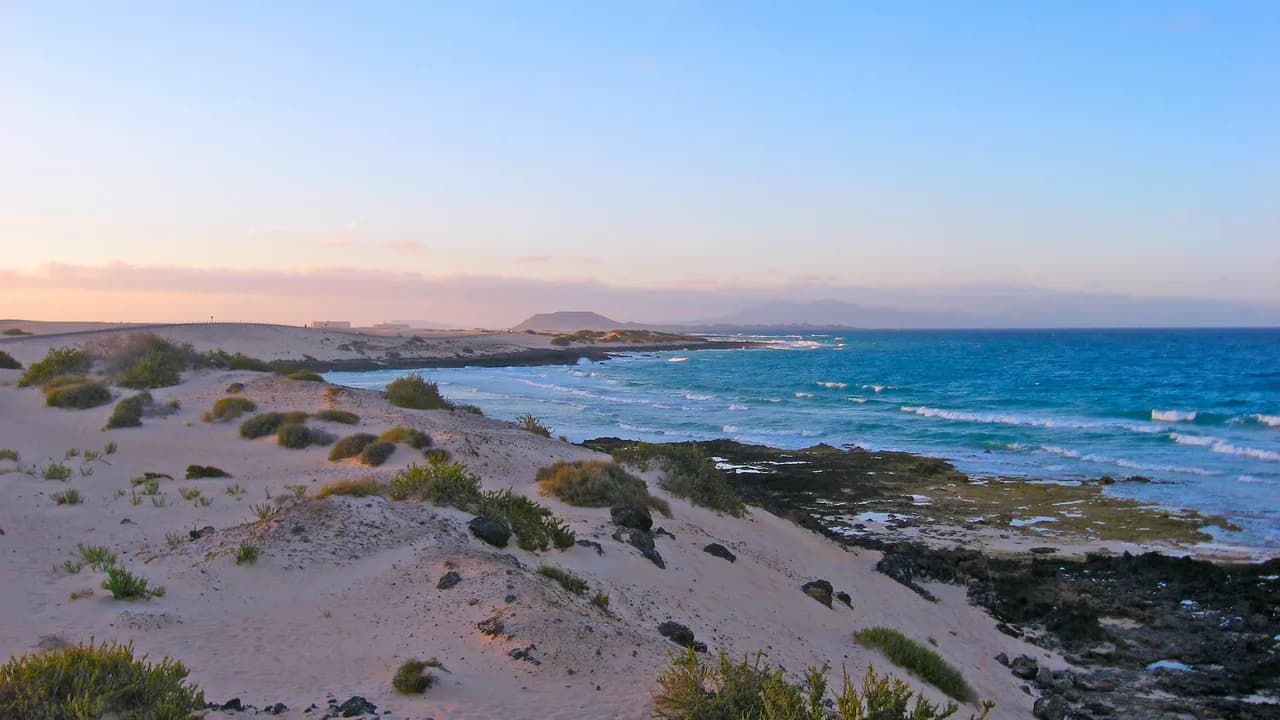
This is prime walking weather. The trails through Betancuria Rural Park, the dunes of Parque Natural de Corralejo and the volcanic interior around Morro Velosa are all comfortable in April and May, when you are not competing with summer heat or crowds. Birdlife and the cactus-filled gardens of the old capital Betancuria are at their best before the dry summer sets in.
If you are weighing up the wider region, our guide to the Canary Islands in April sets out how Fuerteventura compares with Tenerife, Gran Canaria and Lanzarote for warmth, rain and sunshine. It is the honest way to decide whether the windier, more desert-like island suits you better than a greener neighbour. See where is warm in Europe in April for the broader picture across Southern Europe.
Early vs Late Spring: How the Island Changes
Early April still feels like a shoulder season. Daytime temperatures hover around the April average of 22.9 °C (73.2 °F), evenings are mild at 16.0 °C (60.8 °F), and the resorts of Corralejo and Caleta de Fuste are relatively quiet. Some seasonal restaurants and boat operators run reduced hours before the main season, so it pays to book the trips you care about rather than assume they will be running daily.
By late May the island has warmed noticeably, with highs of 24.1 °C (75.4 °F) and lows of 17.1 °C (62.8 °F), and the sunshine climbs to 280 hours. The sea remains brisk, so swimming is for the hardy rather than the whole family, but sunbathing, coastal walks and al fresco dining are all comfortably on the agenda. June pushes on to 25.8 °C (78.4 °F) and near-guaranteed dry days, which is when the island starts to feel like summer proper.
Our guide to the Canary Islands in May explains how the season opens across the archipelago, including which islands warm fastest and where the winds stay strongest. It is worth reading alongside the April figures if you are torn between the two months.
Summer: The Hot, Dry, Busy Stretch
June marks the start of the hot, dry season, and by July and August the island is at its busiest. Days are reliably sunny and rain essentially disappears, but the trade winds can be strong on exposed coasts, especially around Corralejo and the northern beaches. Families who want guaranteed pool-and-beach weather will be happy; walkers and sightseers may find the heat and wind tiring by midday.
The south of the island, around Morro Jable and Costa Calma, tends to be calmer and warmer than the breezy north, which makes it a sensible base if you want less wind. The interior, around Betancuria and Pájara, is hotter still in midsummer but offers shade and dramatic volcanic scenery. If you are travelling in June, our guide to the Canary Islands in June compares the islands before the peak-season crush arrives.
For a wider view of when the archipelago is at its best, the best time to visit the Canary Islands weighs up spring, summer and autumn across all seven islands. It is a useful cross-check if you are not set on Fuerteventura.
Autumn: Warm Seas and Thinning Crowds
October and November are the classic shoulder months. Air temperatures ease back from the summer peak, the sea holds its warmth from the long sunny summer, and the crowds thin out after the school holidays. It is a good window for walkers, photographers and anyone who wants the beaches without the midsummer buzz. Rain becomes more likely as autumn progresses, but the island remains predominantly dry.
Winter: Mild Days, Cool Evenings
Winter is mild by northern European standards, with daytime temperatures that still allow outdoor lunches, coastal walks and sightseeing, and the island is at its quietest. The trade winds continue, and nights can be cool enough for a jacket, which is why winter suits walkers and culture-seekers more than beach-loungers. It is also the wettest part of the year, though rainfall totals remain modest.
If you are planning a winter escape, our guide to the best time to visit sets out how Fuerteventura compares with the other Canary Islands for warmth and sunshine across the year. It is a sensible starting point before you commit to dates.
Which Part of the Island Has the Best Weather
The north, around Corralejo and El Cotillo, catches the full force of the trade winds and is the place to be if you want kitesurfing, windsurfing or bracing coastal walks. The dunes of Parque Natural de Corralejo and the lagoons near El Cotillo are spectacular, but on windy days the sand stings and the water is choppy.
The south, around Morro Jable and Costa Calma, is generally calmer and warmer, with long beaches and a more sheltered feel. Caleta de Fuste in the east is a middle ground, popular with families for its calm bay. The interior, around Betancuria and the volcanic centre, is cooler in summer and offers a break from the coastal wind.
If you want a direct comparison with the bigger island, our guide to the best time to visit Tenerife sets out how Tenerife South Airport's climate compares month by month. It is a useful benchmark if you are deciding between the two.
Winds and the Calima
The trade winds are the defining feature of Fuerteventura's climate. They keep summer temperatures bearable and make the island a world-class destination for wind and kite sports, but they also mean that exposed beaches can be uncomfortable on blustery days. The answer is not to avoid the island but to choose your coast: the sheltered south and the lee of the interior are calmer when the north is blowing hard.
The calima, a hot dusty wind from the Sahara, occasionally affects the islands and can reduce visibility and raise temperatures for a few days. It is not predictable far in advance, so if you are sensitive to dust or heat, build some flexibility into your plans and check local forecasts during your stay. The island's dark skies, recognised with a Starlight Reserve certificate, are one of its quieter pleasures on clear nights.
Crowds and Prices by Season
Spring and autumn are the sweet spot for value: demand is lower than in midsummer, and the weather is still good enough for most activities. The busiest periods are the school summer holidays and the winter sun season, when northern Europeans flock south. Easter can also bring a spike in visitors, so book ferries and popular restaurants ahead if you are travelling then.
Costs vary widely by month, island and booking window, so it is worth comparing package and flight costs for your specific dates rather than relying on general rules. As a rough guide, midsummer and the winter holidays command the highest rates, while late spring and October offer better value.
The Verdict: Which Month Suits Which Trip
For walkers, sightseers and couples who want warm days without the summer crush, late April, May and early June are the best months: highs of 22.9 to 25.8 °C (73.2 to 78.4 °F), very little rain and long sunny days. Families who prioritise beach and pool weather should look at June, when the island is reliably dry but not yet at peak heat.
Avoid midsummer if you dislike wind or crowds, and avoid winter if you want guaranteed beach weather. October and November are the underrated alternative: warm seas, fewer people and a more relaxed island. Whichever month you choose, the trade winds will shape your trip, so plan around them rather than against them.
Plan Your Visit
The best time to visit Fuerteventura is late spring or autumn for most travellers, when the weather is warm and dry, the winds are manageable and the crowds are lighter. If you want dependable sunshine and don't mind the bustle, June and September are strong compromises.
Check current travel advice from the UK government before you book, and use the AEMET normals as your guide to typical conditions rather than a forecast. The island rewards those who plan around its winds and seasons rather than expecting a uniform beach holiday.
More Canary Islands spring guides
Frequently Asked Questions
When is the best time to visit Fuerteventura?
For most travellers, late April to early June and October are the best months. Days are warm, rain is rare and the trade winds are gentler than in midsummer. July and August are hotter and busier, while winter is mild by day but cool after dark.
What is the warmest month in Fuerteventura?
July and August are typically the hottest months, when daytime temperatures peak and rain is essentially absent. Spring and autumn are milder but still warm enough for beach and outdoor activities.
Is Fuerteventura warm in winter?
Winter is mild by northern European standards, with daytime temperatures that allow outdoor lunches and coastal walks, but evenings can be cool enough for a jacket. It is the wettest part of the year, though rainfall totals remain modest.
Which part of Fuerteventura has the best weather?
The south, around Morro Jable and Costa Calma, tends to be calmer and warmer than the breezy north. Corralejo and El Cotillo catch the full force of the trade winds, which suits wind sports but can make beach days bracing.
Is Fuerteventura windy all year round?
The trade winds blow year-round and give the island its name. They are generally strongest in summer and can make exposed northern beaches uncomfortable, but the sheltered south and interior offer calmer conditions.
When is the rainy season in Fuerteventura?
Rain is most likely between October and March, though totals are modest. Spring and summer are very dry, with June often recording no measurable rain at all.
Is Fuerteventura too hot in August?
August brings the hottest and busiest conditions of the year. It suits beach and pool holidays, but walkers and sightseers may find midday heat and strong winds tiring. Consider late spring or autumn if you want to be active.
How does Fuerteventura compare with the other Canary Islands for weather?
Temperatures are very similar across the islands, but Fuerteventura is windier and more arid, with a desert-like landscape. Tenerife and Gran Canaria offer more variety in scenery and shelter from the wind.
Sources
- Tenerife climate normals (AEMET, Tenerife South Airport (AEMET C429I))
- Gran Canaria climate normals (AEMET, Gran Canaria Airport (AEMET C649I))
- Lanzarote climate normals (AEMET, Lanzarote Airport (AEMET C029O))
- Fuerteventura climate normals (AEMET, Fuerteventura Airport (AEMET C249I))
- Winter Sun on Spain's Unspoilt Surfing Island - Fuerteventura - Phil and Garth
- Weather in Fuerteventura
Spring sun notes
Optional updates when we add destinations and months.
You might also like

Continue reading
More guides you'll find useful