Things to Do in Kefalonia in May: Decide Your Warm Week
Plan things to do in Kefalonia in May, from Assos and Fiskardo to Melissani Cave, Mt Ainos walks and Robola wine, with honest notes on crowds and opening.
On this page
May gives you Kefalonia at its most usable: mild, mostly settled days that suit walking, cave visits and long lunches, with cool evenings that still call for a layer and a sea that is only just warming. It is the month when the island works for sightseeing first and lazing second, which is exactly why walkers, couples and families with young children tend to rate it so highly. If you want guaranteed heat and full beach-club service, aim for later in the season; if you want quiet roads and villages without the August crush, May delivers.
May in Kefalonia: warm enough for walking, caves and long taverna lunches
Think of May as the island's walking-and-village month rather than a beach holiday in earnest. Days are generally mild to warm and often sunny, evenings can turn cool especially in the northern hills, and rain spells are possible but usually short-lived; the sea lags behind the land and stays bracing for much of the month. That combination suits hikers, sightseers and anyone planning to spend more time in Assos, Fiskardo and the mountain villages than flat on a sunbed.
Treat these as typical conditions rather than a forecast, and remember that the island's topography does a lot of work: the south around Skala and Lourdas feels warmer and calmer than the exposed north. For a broader comparison of how the island sits against the rest of the Mediterranean in spring, our guide to the warmest places in Europe in April is a useful benchmark for what shifting a few weeks buys you.
Assos and its Venetian fortress
Assos is the island's most photogenic village, a cluster of pastel houses on the isthmus below a ruined Venetian fortress, and in May you can climb to the castle without the midsummer heat turning it into a punishment. The fortress dates from 1590, when it protected dozens of public buildings and hundreds of houses from pirates, and the walk down through its gates gives you views over the bay and the village's pebbled beach. Parking in the village is limited, so arriving early in the day makes the visit far easier.
Pair Assos with the mule track that climbs the mountain behind the village, one of the island's classic half-day walks, and finish with a frappe on the quay. A handful of tavernas and a mini-market serve the village, which keeps it low-key rather than lively. Budget an afternoon rather than an hour: the appeal here is slow, not tick-box.
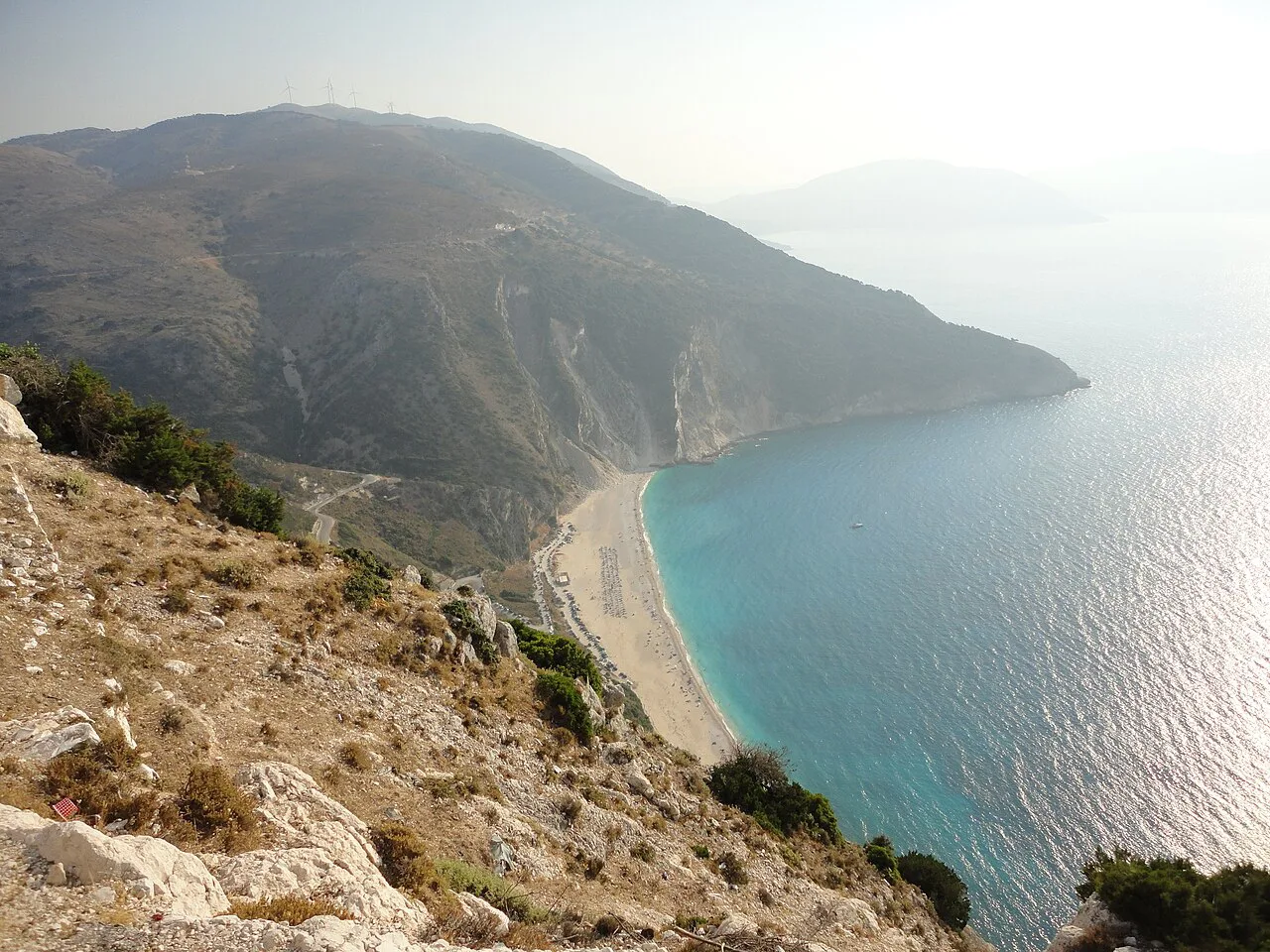
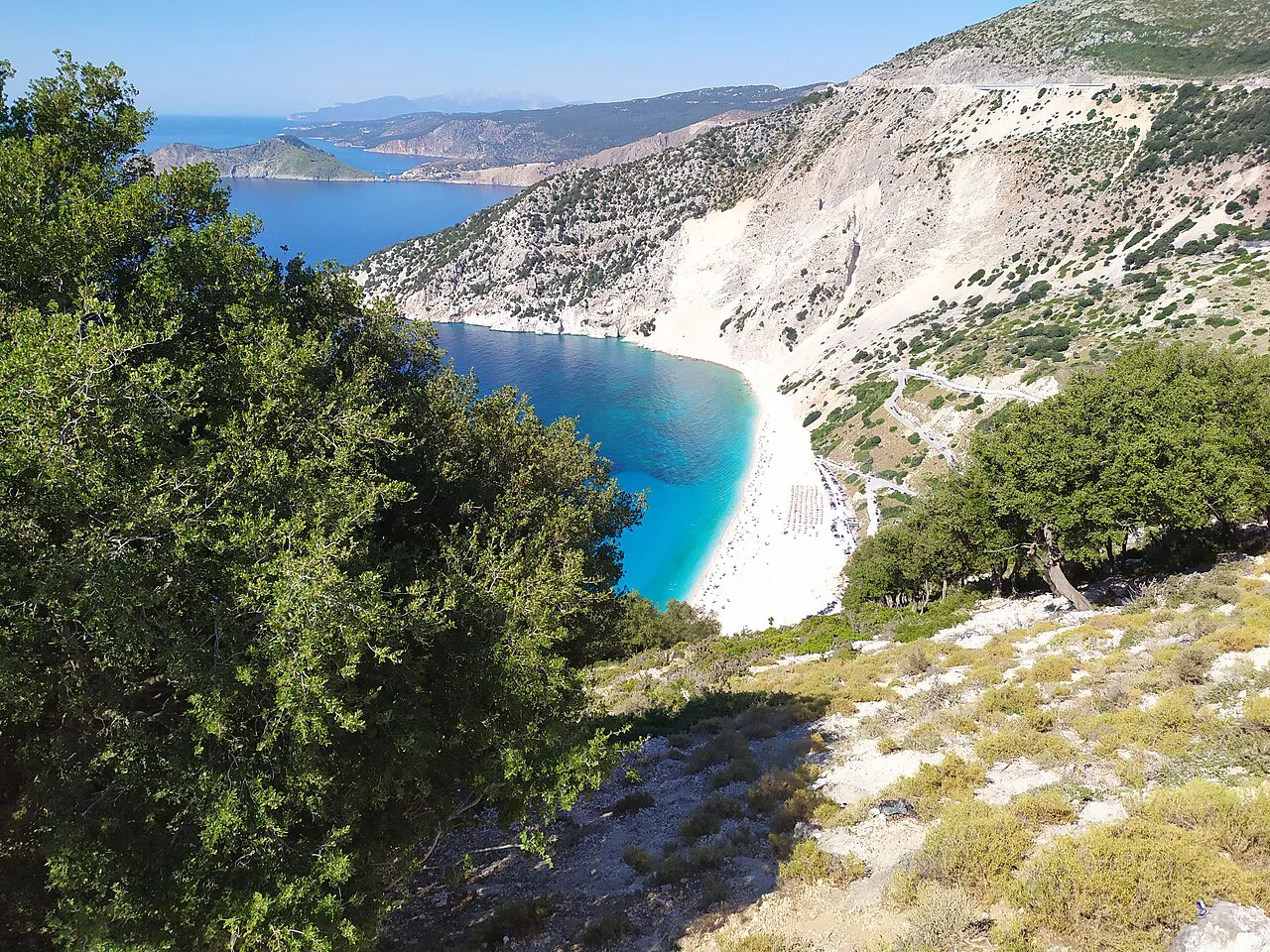
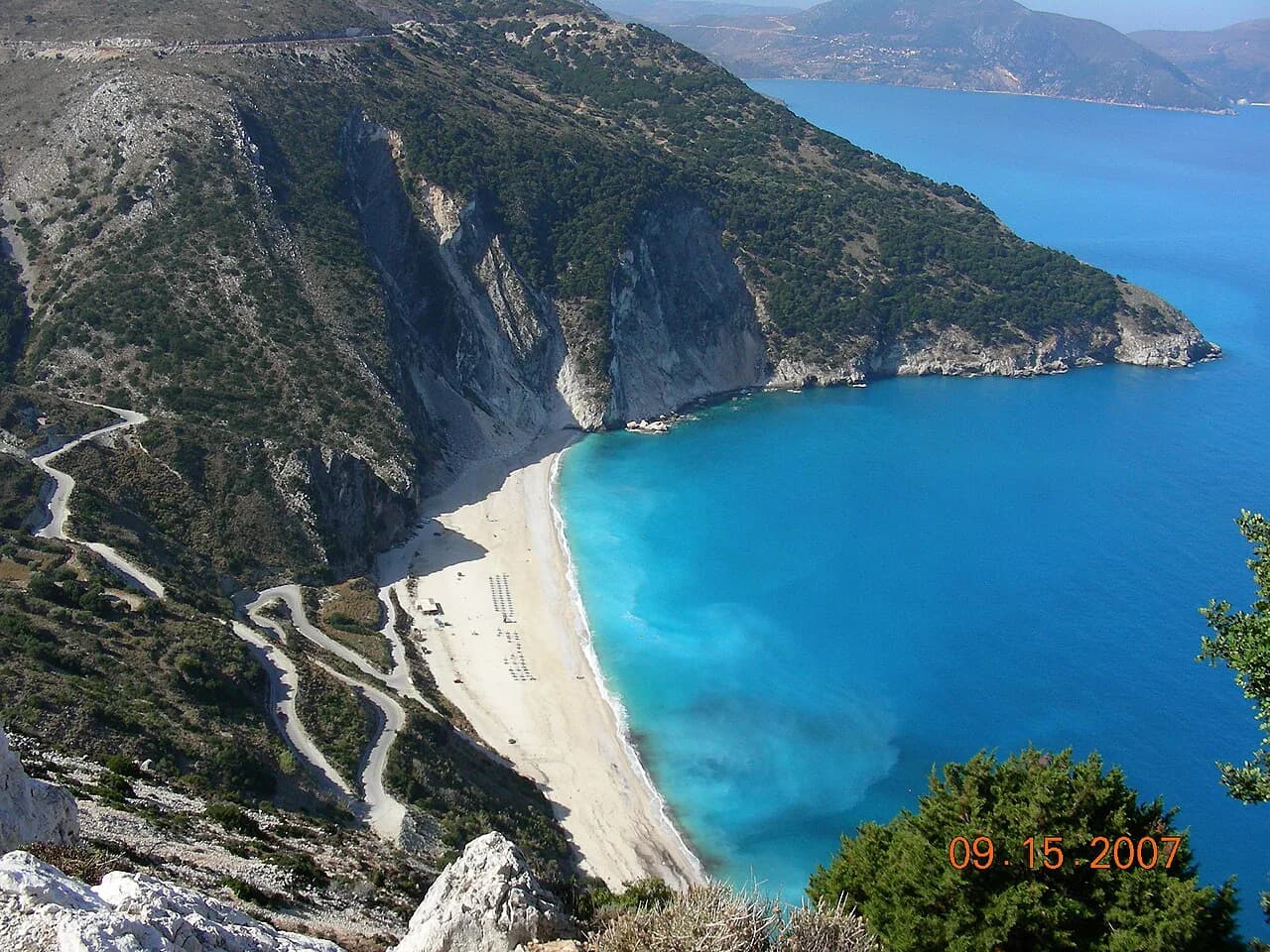
Myrtos Beach from the cliff road
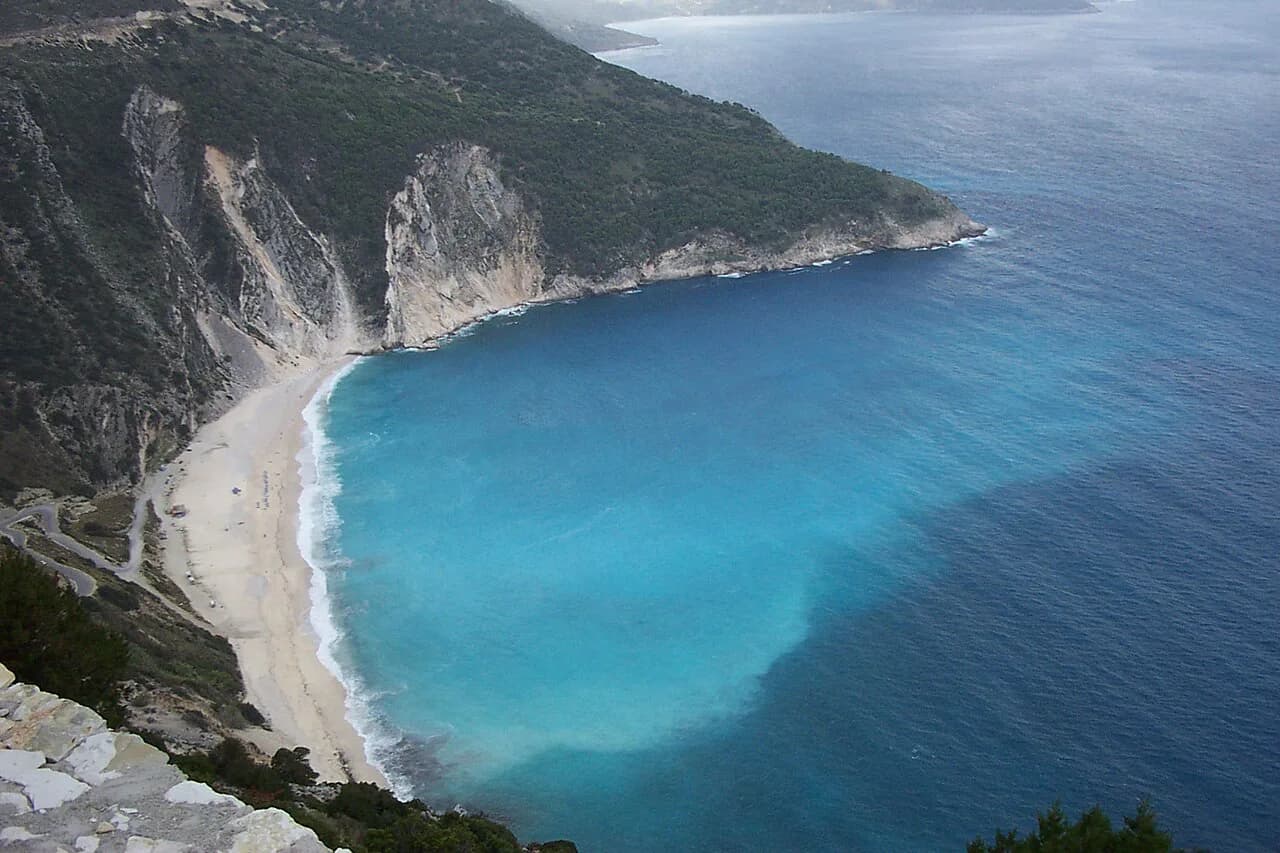
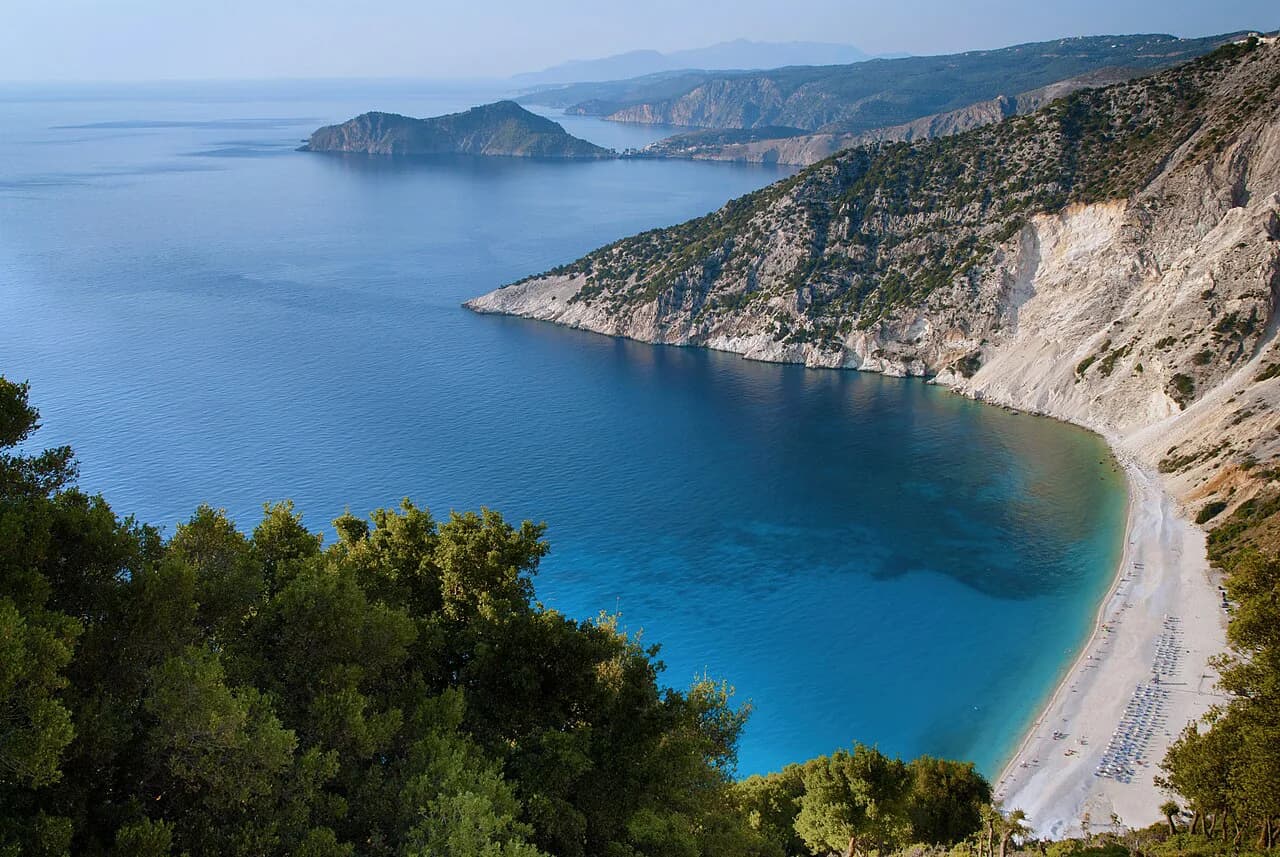
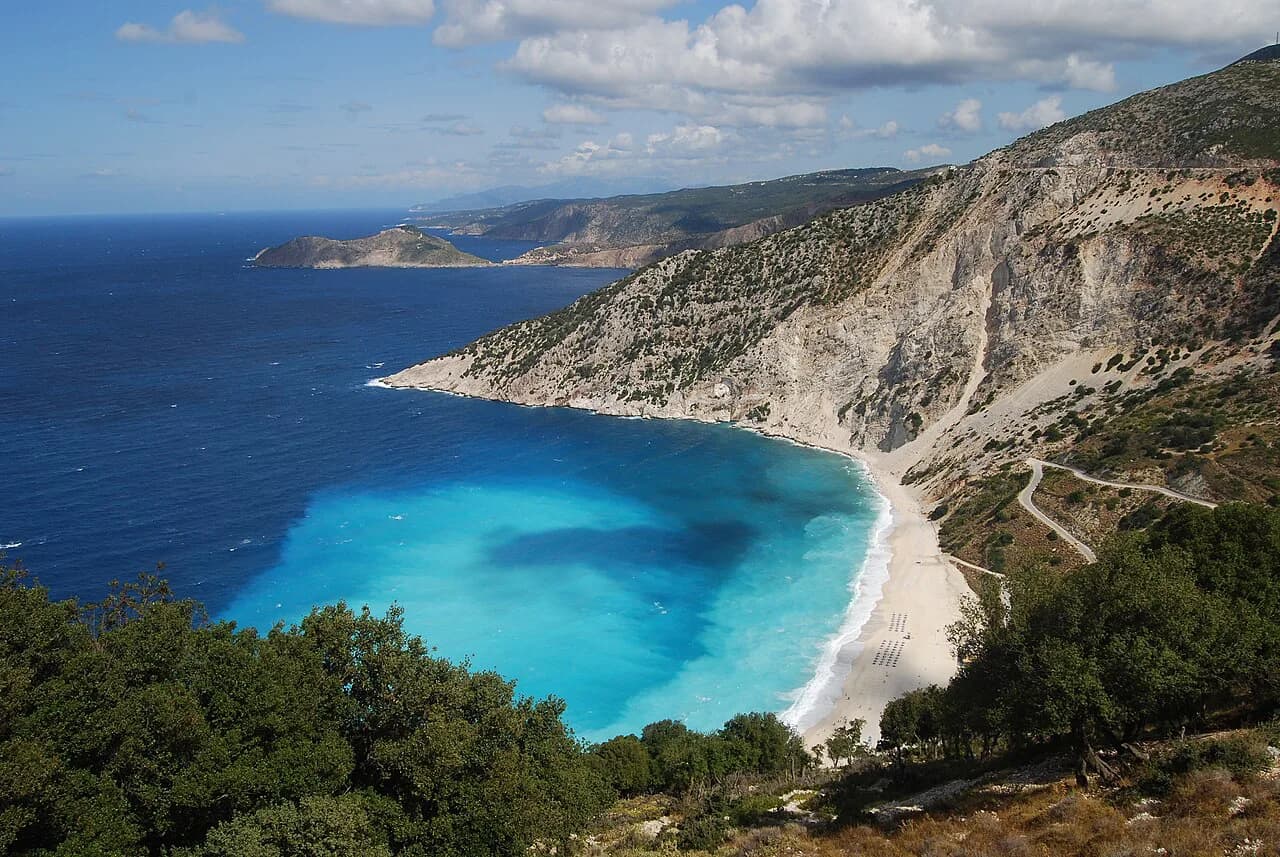
The viewpoint above Myrtos, roughly 320 metres up on the road between Assos and the west coast, is the single most spectacular outlook on the island, and in May you can stop without jostling for space at the barrier. The beach itself is white pebble and vivid blue water reached by a winding asphalt road; in high season a beach club operates on the sand with daybeds and drinks. Whether that club is running in May depends on the season, so treat the beach as a scenic stop and a possible swim rather than a guaranteed sunbed afternoon.
Driving the west coast road south from Assos towards Argostoli takes you past several viewpoints worth pulling over for, and May light is excellent for photography without the haze of August. Allow a full morning for Assos, the Myrtos viewpoint and the descent to the beach, and keep the afternoon free for somewhere closer to your base.
Melissani Cave and Drogarati Cave
Melissani is the island's signature sight: an underground lake beneath a collapsed roof, visited by a short guided rowboat trip of around ten minutes, best timed for late morning when the light beams straight down into the water. Drogarati, a few kilometres away near Sami, is a stalactite chamber with striking acoustics that once hosted concerts. Both are first-timer sights and both are quick, so combining them makes a sensible half-day.
Tickets are modest: a single Melissani ticket is listed at 8 EUR, Drogarati alone at 5 EUR, and a combined ticket covering both at 10 EUR, so the pairing saves a little. Arrive between 11am and 2pm for the best light in Melissani, accepting that this is also the busiest window. The ground inside Drogarati can be damp and slippery, so wear shoes with grip.
Fiskardo and the Ithaka Channel by boat
Fiskardo survived the 1953 earthquake and remains the island's only substantial piece of Venetian architecture, a harbour of bougainvillea, tavernas and yachts on the northern tip. In May the harbour is lively without being overwhelmed, and the people-watching from the waterfront tables is half the point. It is also the best base for getting out on the water towards Ithaka.
Boat trips leave Fiskardo most mornings in season, calling at beaches and harbours around the Ithaka Channel, with some routes reaching the sea caves on Meganisi; daily ferries also run to Ithaka and Lefkada. In May the water can be choppy and the crossings cooler than in summer, so pick a calm day and check current sailings and routes before you commit a day to it. Motorboat hire from the harbour is an alternative if you want to explore at your own pace.
Argostoli: the fish market, the platia and the causeway
Argostoli is a working capital rather than a resort, rebuilt after the 1953 earthquake, and its pleasures are everyday ones: the morning fish market where taverna owners buy their catch, the fruit and vegetable stalls, the palm-lined coastal road, and a main square packed with tavernas and bars. The archaeological and folklore museums are small and worth an hour each, and the shops range from leather and ceramics to the island's characteristic silver and gold.
The pedestrian causeway across the water is a pleasant early-evening walk, and lucky visitors spot turtles in the bay. Use Argostoli as a rainy-day or rest-day base: it has the island's densest concentration of indoor things to do when a May shower passes through.
Old Vlachata, the abandoned village above Sami
Old Vlachata is one of the villages abandoned after the 1953 earthquake, a hillside of crumbling facades, wells and stone ovens being slowly reclaimed by trees, and it is a genuinely atmospheric hour on foot. It sits roughly five kilometres from Sami and Karavomylos, which makes it an easy add-on to a Melissani and Drogarati morning rather than a separate expedition. Wear proper shoes: the ground is uneven and overgrown.
Mt Ainos National Park on foot
Mt Ainos is the island's highest mountain at about 1,628 metres and the only national park in Kefalonia, more than 3,000 hectares of Greek fir and black pine with trails and viewpoints across the interior. The classic route is the Megas Soros trail to the summit, a demanding walk of around four and a half hours that rewards you with views over the limestone ridges and the Ionian. May is the month to do it: the forest is green, the heat has not built, and the mountain offers a completely different island from the coastal villages.
Check the day's conditions in the mountains before setting out, since cloud can close in quickly on the summit even when Argostoli is sunny. Carry more water than the temperature suggests and start early enough to finish comfortably. If a four-hour ascent sounds too much, the lower forest tracks and viewpoints still give you the fir woods without the full climb.
Robola wine and the wineries near Orealios Gaea
Robola is the island's signature grape, grown on the steep rocky slopes below Mt Ainos, and visiting a winery is one of the best indoor-outdoor activities for a mixed-weather May day. Orealios Gaea and Haritatos Estate both run visits and tastings, and the monasteries and vineyards cluster in the same central area under the mountain, which makes them easy to string together.
Expect modest, low-intervention winemaking rather than grand chateau hospitality, and ask about tasting availability when you arrive since a working estate's schedule follows the vineyard. Combine a tasting with lunch in a mountain village and you have a full day that does not depend on the beach.
Agios Gerasimos monastery
The monastery of Agios Gerasimos, dedicated to the island's patron saint, is a pink-walled complex of frescoes, a plane-tree courtyard and a silver reliquary, with a trapdoor leading to the cave where the saint is said to have lived as a hermit. It sits next to the Orealios Gaea winery under Mt Ainos, so pairing the two is straightforward. Both the monastery buildings are free to visit.
Dress respectfully, since this is an active pilgrimage site rather than a museum, and keep voices low if a service is under way. A morning here followed by a tasting and a long lunch is one of the most satisfying May itineraries on the island, and it works whatever the weather does.
Castle of Agios Georgios
The ruined Castle of Agios Georgios sits on a hill about fifteen minutes from Argostoli, a Byzantine fortress whose overgrown walls frame views of Mt Ainos and the sea. Entrance is listed at 3 EUR per person, with the grounds published as open daily from 8.30am to 3.30pm except Tuesdays, so plan it as a morning stop rather than an afternoon one. The romantic ruined quality is the appeal, so give it an hour rather than a day.
Antisamos and the east-coast beaches before the season fills
Antisamos, a shingle bay about a mile east of Sami up a mountain road, is the east coast's most photogenic beach and famously featured in Captain Corelli's Mandolin. In May you get it without the summer crowd, though the sea is still cool enough that many visitors walk rather than wallow. It pairs neatly with a Sami-based day of caves and Old Vlachata.
Agia Efimia, half an hour or so from Fiskardo, is a pretty harbour village of waterside tavernas and a narrow shingle beach with views across the Ithaka Channel, and a good lunch stop between the north and Sami. The east coast rewards slow driving: the roads are narrow and the rewards are views rather than speed.
Skala and the south, including the turtle nesting beach
Skala in the south pairs a long sandy beach with the remains of the old village destroyed in 1953, including the wash house, bell tower and olive press, plus around twenty tavernas and restaurants that make it a good evening out. Further along the beach there is a breeding sanctuary for endangered sea turtles, which is a reason to keep to the marked areas and give the sand space where it matters. The temple of Apollo and the church of Saint George are just outside the village on the Poros road.
Lourdas, on the south coast, is quieter still, a long sandy beach with a small row of waterfront tavernas and a mountain backdrop that produces fine sunsets. Both are useful May bases if you want warmth, space and easy driving rather than village atmosphere.
Early vs late May: what changes as the season opens
Early May is the quieter, cooler option: roads are empty, village tavernas are open but unhurried, and the island feels like it belongs to residents. Late May brings warmer days, fuller harbour fronts in Fiskardo and Argostoli, and a better chance that beach clubs and boat operators are running properly, though the difference from early to late is gradual rather than a switch. If your trip is built around walking and villages, early May is the better trade; if it is built around being on the water, later is safer.
Compared with April, May is warmer and more reliable; the earlier month suits tougher walking and emptier sights, which our guide to Kefalonia in April covers in detail. Compared with June, May gives up some heat and settled evenings in exchange for thinner crowds and gentler conditions on the mountain.
If your dates are fixed around the first half of the month, Kefalonia in May sets out what the island offers base by base, and Kefalonia in June shows what you gain by holding off a few weeks as the sea warms and the summer operations get into their stride.
Crowds and prices in May
May sits comfortably before the July and August peak, when Argostoli in particular fills with tourists, so you get accommodation and taverna tables without the crush. Road traffic on the narrow mountain routes is light, and the big sights such as Melissani and Drogarati are busy mainly in the late-morning window rather than all day. If you can travel in the first half of the month, you will notice the difference.
On costs, the cave tickets are the clearest figures: 8 EUR for Melissani, 5 EUR for Drogarati, 10 EUR combined, and 3 EUR for the Castle of Agios Georgios. Taverna and accommodation prices are not published in any consistent form, so treat May as shoulder season and expect to pay less than in high summer without assuming any specific figure.
May or June?
Choose May for walking, caves, ruins and villages with room to breathe, and for the version of Kefalonia where the interior matters as much as the coast. Choose June if your priority is reliably hot days, warmer sea and the full summer operation of boats and beach clubs, accepting busier roads and hotter climbs. The honest trade-off is comfort versus certainty: May is more comfortable, June is more guaranteed.
If you have flexibility across the wider region, our guide to the best time to visit Kefalonia sets the month-by-month comparison against the island's neighbours, and the Greece in April guide shows what you gain by waiting a few weeks into May.
The verdict
May is the best month on Kefalonia for doing rather than lying down: Assos and its fortress, the Myrtos viewpoint, the caves at Melissani and Drogarati, the abandoned lanes of Old Vlachata, Mt Ainos on foot and Robola tastings under the mountain all work better now than in high summer. Base yourself in Argostoli or Sami for the caves and interior, Fiskardo or Assos for the north, and Skala or Lourdas for warmth and space, and group sights by base rather than criss-crossing the island.
Go early in the month for quiet and cool walking, or late for warmer seas and a more fully open season, and accept cool evenings either way. For the official entry requirements for British and US visitors, see the UK government's travel advice for Greece before booking.
More Kefalonia spring guides
Frequently Asked Questions
Is May a good time to visit Kefalonia?
Yes, for most travellers it is the best-balanced month. Days are mild to warm with sunny spells, evenings can be cool, and the sea is still warming, so it suits walking, villages, caves and ruins better than a beach-focused trip. It is also noticeably quieter than July and August.
Is Kefalonia warm in May?
Generally mild to warm by day, with cooler evenings especially in the northern hills, and possible short rain spells. The sea lags behind the land and stays cool for much of the month. Treat it as spring walking weather rather than guaranteed beach heat.
How many days do you need in Kefalonia?
At least four days to cover Argostoli, the central sights and one of the northern villages without rushing, and five to seven if you want Mt Ainos, the wineries and a boat trip as well. The island is larger than it looks on the map, and drives between bases take longer than the distance suggests.
Which part of Kefalonia is nicest in May?
The north around Assos and Fiskardo is the most atmospheric, while Sami is the most practical for caves and the east coast, and Skala and Lourdas in the south are the warmest and quietest. Argostoli works best as a base for the centre and for wet-weather days.
What does the Melissani Cave visit cost?
Melissani, Drogarati Cave and a combined ticket covering both are sold at different rates, and the ticket office displays the current tariffs when you arrive. Check current details on the official price list before you buy.
Which beach in Kefalonia has turtles?
A stretch of Skala beach in the south is a breeding sanctuary for endangered sea turtles. Keep to marked areas and give the nesting sand space, and ask locally which sections are protected at the time of your visit.
Can you visit Mt Ainos in May?
Yes, and May is a good month for it: the fir forest is green and the summit has not yet turned hot. The Megas Soros route to the top takes around four and a half hours, so start early, carry water, and check conditions in the mountains before setting out.
Do you need a car in Kefalonia?
A car makes a huge difference. Buses are limited, the sights are spread across the island, and a car lets you combine Assos, Myrtos, the caves and the wineries into sensible days. In May the mountain roads are quiet, though narrow.
Sources
Spring sun notes
Optional updates when we add destinations and months.
You might also like
Continue reading
More guides you'll find useful